Guest Lectures with Professor Karen Scott and Professor Anastasia Telesetsky
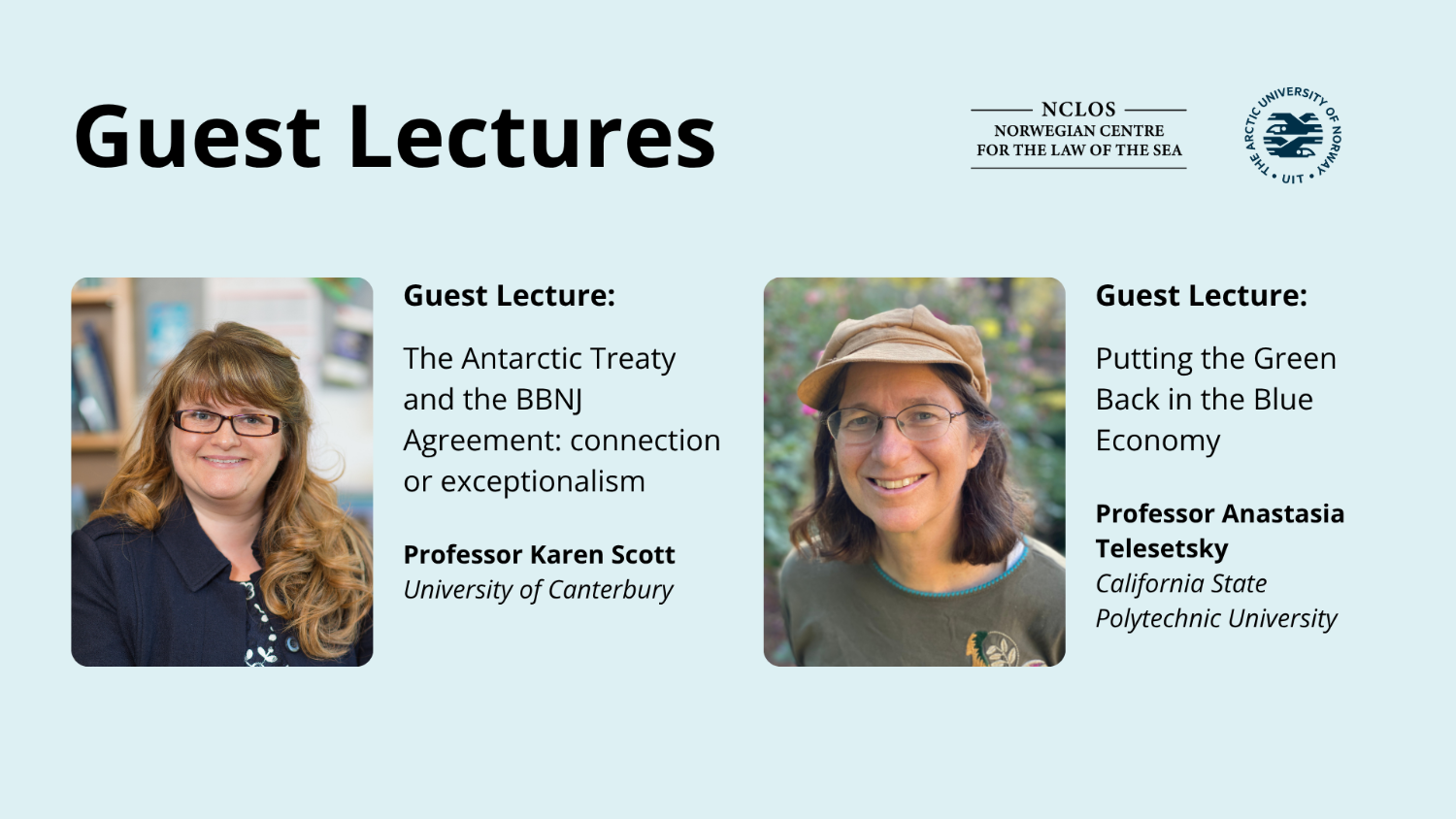
Welcome to two exciting guest lectures, hosted by The Norwegian Centre for the Law of the Sea, The Faculty of Law, UiT:
This lecture is based on an article that explores the concepts of Antarctic ‘exceptionalism’ versus Antarctic ‘connection’ in the context of the effectiveness and legitimacy of Antarctic governance. Scott argues that the version of Antarctic exceptionalism which is exclusionary of other regimes is not an inevitable and natural consequence of the principles or the processes of the 1959 Antarctic Treaty. Her article explores three modes of Antarctic connection as developed by the Antarctic Treaty Consultative Meeting (ATCM): explicit reliance on external regimes for the regulation of activities in the Antarctic, such as shipping or air travel; implicit recognition of regimes through moderation of its own governance of activities to take account of those regimes; and direct collaboration with external regimes. Two case studies, focusing on shipping (and the IMO) and climate change demonstrate different modes of ATCM collaboration and provide useful lessons that the ATCM could draw on for the purposes of future collaboration, in particular, with the 2023 BBNJ Agreement. The article concludes with specific and practical recommendations as to what action the ATCM might take to begin connecting with the BBNJ Agreement in order to strengthen both the effectiveness and legitimacy of Antarctic Treaty system governance in the Southern Ocean.
Karen N Scott is a Professor of International Law at the University of Canterbury in New Zealand. She is the Editor-in-Chief of Ocean Development and International Law (ODIL). Karen is on the board of seven journals including the Brill Research Perspectives on the Law of the Sea and the Australian Yearbook of International Law. Karen has published over 100 edited books, journal articles and book chapters in the areas of the law of the sea, international environmental law and Polar law. She is the co-editor of the Oxford Handbook of the Law of the Sea (OUP, 2015), the Research Handbook on Polar Law (Edward Elgar, 2020) and the Research Handbook on International Environmental Law (Routledge, 2021). Recent projects have focused on a critical analysis of environmental impact assessment and the ‘equivalence exception’ under the 2023 BBNJ Agreement (International Journal of Marine and Coastal Law, 2026) (with Neil Craik), the Antarctic Treaty System and the BBNJ Agreement (ICLQ, 2025), and climate change and the law of the sea (CUP, forthcoming). Karen was the recipient of the 2021 Legal Research Foundation Sir Ian Barker Published Article Award for “Does Aotearoa New Zealand Need an Oceans Policy for Modern Ocean Governance?” 35 (2021) Ocean Yearbook 273 – 339. Karen was Head of the School of Law at the University of Canterbury from 2015 to 2018, Acting Executive Dean of Law 2023 – 2024, Associate Dean (Research) (2022 – 2025) and President of the Australian and New Zealand Society of International Law (ANZSIL) (2019 – 2023).
Marine and coastal ecosystems are undergoing accelerating degradation even as governments increasingly promote “blue economy” strategies. This lecture argues that the blue economy’s original promise—linking ecological sustainability, community well-being, and economic activity—has been displaced by “blue growth” models that prioritize extraction, sectoral expansion, and financial returns. In response, it advances the concept of an “aqua economy”: an approach grounded in Earth Law, ecological interdependence, reciprocity, and restoration rather than continued commodification of ocean systems. Drawing on the Kunming–Montreal Global Biodiversity Framework, the UN Decade on Ecosystem Restoration, the restorative continuum, and the European Union’s Nature Restoration Law, the presentation identifies large-scale marine and coastal restoration as a core economic and governance priority. It contends that private finance alone cannot deliver restoration at the scale or duration required and that governments and communities must provide sustained institutional, legal, and financial support to achieve objectives of an Aqua Economy. The presentation recommends dedicated restoration institutions, participatory and place-based planning, redirection of harmful subsidies, long-term public investment, and workforce development in restoration-related skills. Reframing the blue economy as an aqua economy, it concludes, can align livelihoods and governance with ecological regeneration, social dignity, and intergenerational responsibility.
Anastasia Telesetsky is a Professor in the Department of Natural Resources and Environmental Sciences, California State Polytechnic University San Luis Obispo in the United States. Professor Telesetsky’s research focuses on marine environmental protection, food security, disaster risk reduction, and ecological restoration . She is the co-author of Ecological Restoration in International Environmental Law, the textbook Comparative and Global Environmental Law and Policy, the West Publishing House Nutshell on Ocean and Coastal Law and an edited book Comparative Environmental Law. She is currently preparing with co-authors a book on the future research pathways for biodiversity law. She is the editor of the State Practice section of the Asia Pacific Journal of Ocean Law and Practice and a member of the IUCN World Commission on Environmental Law and the Ocean Law Specialist Group. She is member of the International Law Association’s Committee on Protection of Persons at Sea.
The guest lectures are open for everyone to attend and do not require registration.