CANS seminars
Noviembre 04. 2026 – Noviembre 05. 2026
CANS day 2026
Where: To be announced – TromsøWhen: Noviembre 04. 2026 at 12:00 – 13:30
4-5 November, lunch-to-lunch with scientific updates and social networking!
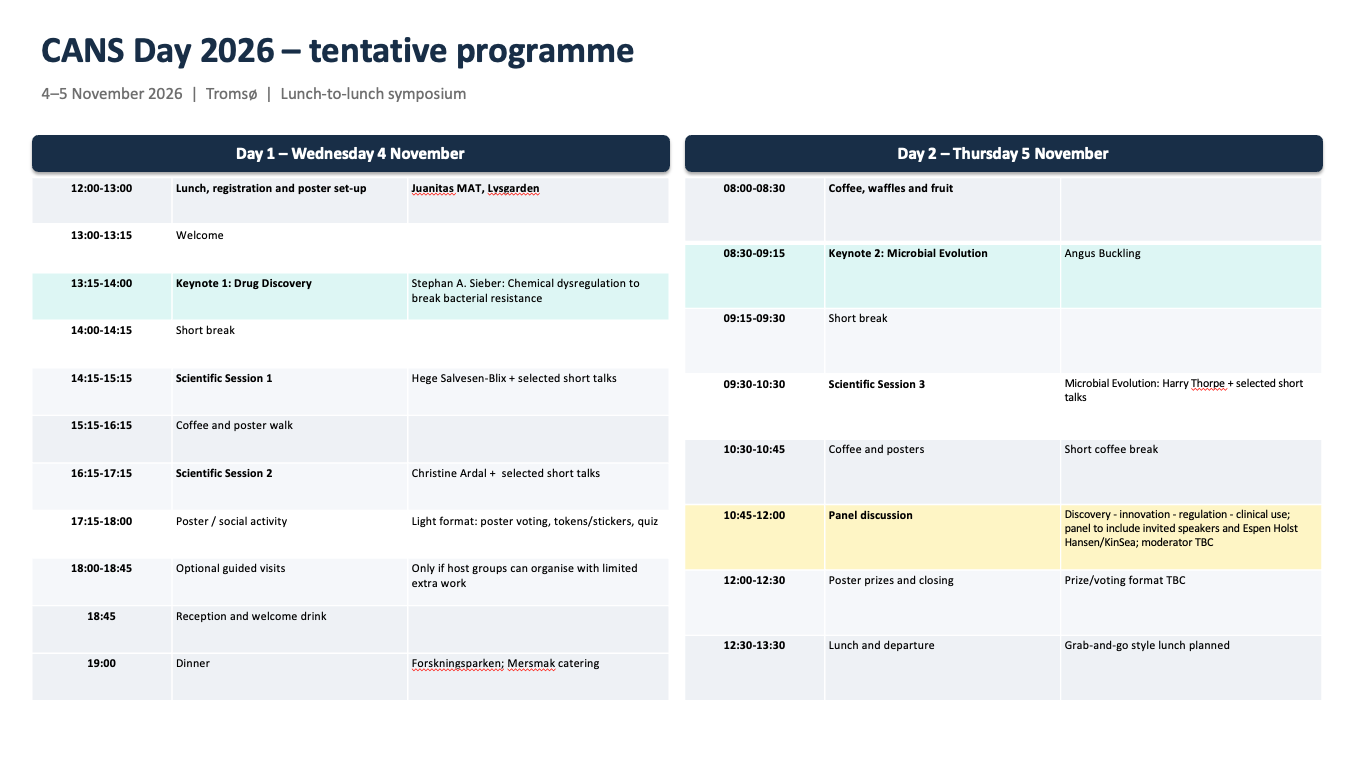
We are happy to invite you to CANS Day 2026, which will take place on 4–5 November 2026 in the MH building at UiT. This year’s CANS Day will be organised as a lunch-to-lunch.
There will be two tracks:
- Drug Discovery
- Evolution
Please see the attached tentative program for details.
Registration and abstract submission
The deadline for registration and abstract submission is 25 September 2026. Please register and submit abstracts here:
https://nettskjema.no/a/cans-day-2026
We hope many of you will join and contribute to making this a lively and useful CANS Day.
Invited speakers:
- Angus Buckling, University of Exeter - microbial evolution
- Stephan A. Sieber, Technical University of Munich - drug discovery
- Harry Thorpe, University of Oslo
- Hege Salvesen-Blix, Norwegian Institute of Public Health
- Christine Årdal, Norwegian Institute of Public Health
Full programme and venue to be announced. Day 2 will include a panel discussion.
Abstract deadline: September 25
Organising committee
- Veronika K. Pettersen
- Elizabeth G Aarag Fredheim
- Yannik Karl Heinz Schneider
- Jakob Peder Pettersen
- Natasa Skalko-Basnet
- Cindy Jittrapan Given
- Juliana Miranda Tatara
Contact person for the 2026 CANS Day
Veronika K. Pettersen
veronika.k.pettersen@uit.no
Link to this page
Noviembre 16. 2026 – Noviembre 16. 2026
Clinical perspectives on AMR
Where: MH-building, auditorium 2 – TromsøWhen: Noviembre 16. 2026 at 14:00 – 16:00
A CANS-seminar with focus on clinical microbiology. Presenters:
Iren Høyland Löhr, Stavanger University Hospital:
TBA
Paul Christoffer Lindemann, Haukeland University Hospital:
Beyond S, I and R: The Hidden World of Clinical Breakpoints
How microbiology, pharmacology and clinical evidence are translated into treatment decisions
Paul Christoffer Lindemann is a lead consultant clinical microbiologist at the Department of Microbiology, Haukeland University Hospital, Bergen, Norway. He serves as Vice Chair of both the European Committee on Antimicrobial Susceptibility Testing (EUCAST) and the Norwegian Working Group on Antibiotics (NWGA/AFA), and has represented Norway on the EUCAST Steering Committee since 2015.
His work focuses on antimicrobial susceptibility testing, antimicrobial resistance, clinical breakpoint development, and the integration of medical microbiology into clinical decision-making. He is actively involved in developing and implementing susceptibility testing standards and guidelines at both national and international levels, with the aim of improving antimicrobial therapy and patient care.
Kristoffer H. Endresen, Nordland Hospital:
“Costly and cool, but is it a useful tool?” Rapid diagnostics of bloodstream infections (BSI) in a North Norwegian setting.
Where does the evidence on rapid diagnostics for BSI point us? Is it transferable to faraway regions with unpredictable specimen logistics?
Kristoffer H. Endresen is consultant clinical microbiologist at Nordland Hospital Trust in Bodø. He is also a PhD-student at UiT – The Arctic University of Norway, focusing on diagnostic stewardship: implementation of new diagnostic methods, rapid diagnostics, antimicrobial stewardship and antimicrobial resistance.
Link to this page